

He Doesn’t Justify Rape. She Does.
Doug Wilson posted this today. The day after International Women’s Day. Last month he preached at the building where men in air-conditioned offices decide who lives and who dies. Let's talk.

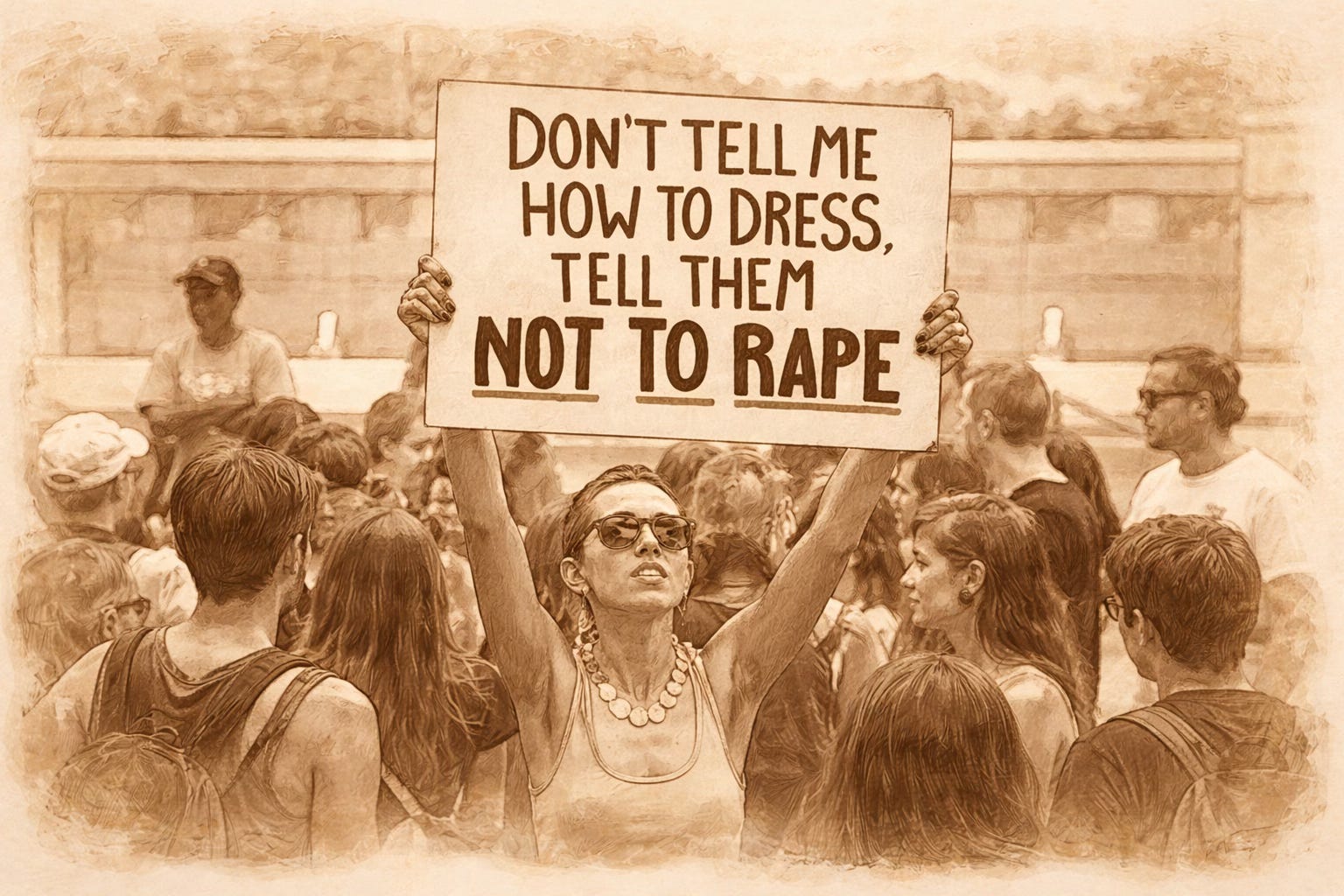
I read it with my coffee this morning and my stomach turned.
Not metaphorically. My body registered something before my theology could catch up — a nausea, a tightening — that I’ve learned, after years studying psychology and sitting with people in pain, to take seriously as information rather than weakness.
Wilson would say that’s exactly the problem. That I’ve made my inner life an idol. That feelings aren’t facts.
He has a lot to say about idols.
We’ll come back to that.
What He Actually Said
Last month, Douglas Wilson — who has been doing this since 1977, nearly fifty years, long enough to build a church, a college, a publishing house, a denomination, and a pipeline to the White House — stood inside the building that houses the nerve center of American military power and spoke. The place where wars are planned and drone strikes authorized. Where men in air-conditioned offices move pieces on a map and human beings on the other side of the world become targets. Where the nuclear arsenal that could end human civilization several times over is managed, maintained, and pointed at things.
He stood in that building and preached: Lord, we are your people.
This morning, the day after International Women’s Day, he republished a 2015 piece called “A Theology of Slut Walks.”
His argument, charitably stated: you cannot say “rape is always wrong” without appealing to a shared moral standard. If you reject objective morality — if you march insisting your behavior carries zero moral weight — you’ve sawed off the branch you need to condemn the man who raped you.
As a philosophical claim, it’s not entirely wrong.
Which makes this sentence all the more chilling:
“I am simply pointing out that his victim was a person who had given herself to organizing events built on a theology that, when applied consistently elsewhere, fully justifies rape. I do not justify rape; she does.”
Read it again.
I do not justify rape. She does.
The woman who was kidnapped and raped — in Wilson’s own hypothetical — justified her own rape. Not the man who raped her. Her.
Wilson wants you to understand he’s making a philosophical point, not a moral judgment. Just following the logic. Just the messenger.
This is the most dangerous kind of argument: one that uses the formal machinery of logic to reach a conclusion that any undamaged human nervous system immediately recognizes as monstrous — and then insists that your revulsion is the problem.
Your stomach turning? That’s your idol talking.
The Idol Wilson Is Actually Worshipping
Wilson talks about idols constantly. Emotions are an idol. Therapeutic culture is an idol. The inner life is an idol. He has built a nearly fifty-year career identifying the false gods of progressive culture and calling his people to repentance.
So let me name his.
The idol Douglas Wilson worships is Male Intellectual Authority — the belief, so deep it functions as air, that the man with the argument always outranks the woman with the wound. That logic, wielded by the right kind of man, is the highest court of appeal. That if the philosophical framework holds, the human cost is someone else’s problem — specifically, hers.
This idol has a long history. It built empires. It wrote legal codes that treated women as property. It constructed elaborate theological justifications for why the people crushed at the bottom of every hierarchy deserved to be there. It has always been sophisticated. It has always cited Scripture. It has always been absolutely certain of itself.
And it has always, when confronted with a woman in pain, found a way to make the pain her fault.
The serrated edge, it turns out, only cuts in one direction.
What This Does In a Body
I want to speak directly to any woman reading this who has been sexually assaulted.
When Wilson performs his philosophical surgery on the rape victim in his hypothetical — stripping her of victim status, relocating the source of her violation in her own ideas — something in the body responds to that as an act of violence.
Because it is.
In trauma psychology this is called secondary wounding — the additional harm done when the systems around a survivor respond in ways that compound the trauma rather than witness it. Wilson’s argument is secondary wounding with footnotes.
If you read this and something in you flinches or closes or goes quiet — that is not weakness. That is your body being a reliable witness to what this argument is doing beneath the philosophical apparatus.
Your body is telling you the truth.
Wilson would tell you trusting your body is an idol.
Jesus called a woman daughter after twelve years of hemorrhaging had made her ritually unclean, socially untouchable, and theologically disqualified by every framework available to him.
He didn’t audit her worldview first.
The Move That Has Always Been Made
Wilson is doing what authoritarian systems have always done with women’s bodies: making her responsible for the violence done to her by locating its origin in her ideas rather than his actions. The rapist becomes a logical consequence of her premises — clicking into place like a proof. She built the world in which he was possible. He just lived in it.
If Wilson said she was asking for it he’d be dismissed instantly. But her theology, applied consistently, fully justifies rape — now he sounds like a philosopher. Now the burden shifts to you to refute the logic rather than to him to reckon with what he just said about a rape survivor.
Victim-blaming dressed in a doctoral gown. Spritzed with pipe smoke. Published the day after International Women’s Day.
By a man who last month stood in the building where human beings are converted into coordinates — where the decision to end a life is made by someone holding a coffee cup in a climate-controlled room — and asked God to bless it.
These are not unrelated.
The man blessing the machinery of empire is the same man telling rape survivors they justified their own assault.
One idol. Two altars.
How Jesus Dismantles This In Eight Words
The woman caught in adultery — dragged into the temple square, used as a philosophical prop in an argument about the law, which is exactly what Wilson is doing with his rape victim — Jesus didn’t audit her theology. Didn’t ask whether her worldview was internally consistent. Didn’t note that her behavior had created the conditions for her humiliation.
He bent down and wrote in the dirt while the men with the frameworks waited for his answer.
Then: let the one without sin cast the first stone.
He aimed the moral framework at the people wielding it. Not at her.
Where are your accusers? Has no one condemned you? Neither do I.
Eight words.
Wilson’s argument is a stone. Philosophically polished. Logically weighted. Aimed at a woman on the ground.
Jesus knelt in the dirt and asked where her accusers went.
That is the Son of God dismantling the oldest idol in human history with a question in the dirt.
Why He Posted This Today
Wilson knows what day it was yesterday. He knows what this piece says about rape survivors. He has been doing this for nearly fifty years — the provocative post, the serrated edge, the some might say that was a little preachy and puritanical caption beneath a photograph of women marching.
The outrage is the product.
Every horrified response confirms the narrative to his people: the world hates us because we tell the truth. We are persecuted for righteousness. The dopamine loop of certainty runs on conflict. It requires an enemy.
Last month: the building where human beings become targets.
This morning: she justified her own rape.
One theology. Two expressions. One idol with many faces.
This is what it looks like when a nearly fifty-year theological project fuses with institutional and political power. It doesn’t get softer. It doesn’t get more merciful. It gets a Pentagon badge and a publishing house and a pipeline to the men who decide which countries we bomb.
And it posts this the day after International Women’s Day.
What I Want to Say to Him
Doug, I used to worship in churches shaped by your theology. I know the argument. I know you believe you are doing the hard thing that softer men won’t do.
But I want to ask you one question.
When a woman who has been raped reads I do not justify rape; she does —
What do you want to happen in her body?
Because I cannot find a single moment in the Gospels where Jesus looks at a woman who has been violated and says: before we proceed, let’s examine your theological framework.
He stopped.
He asked.
He healed.
He called her daughter.
The man who preached at the center of American military power — who blessed the missiles and the men who aim them — cannot find room in his theology for that kind of stopping.
That is not courage. That is not the hard thing softer men won’t do.
That is the oldest idol in the world, wearing a Geneva gown.
And it is not the kingdom Jesus described.
Jesus said that kingdom is yeast — hidden, small, working from the inside out, impossible to stop.
It does not need a Pentagon.
It does not need fifty years of institutions and influence and pipelines to power.
It does not need stones.
It just needs to be hidden in the flour.
And it cannot be stopped by the men who think they’re building it.
Trevor Mauss writes at Sanctus — for people who left the building to find the church. He attended Covenant Theological Seminary, The Seattle School of Theology and Psychology, co-planted Christ Church Bellingham (which he left), and has spent years at the intersection of theology and psychology.
☕ Sanctus runs on coffee. If it helped you breathe, you can buy the next cup.
